Preamble
Since this website launched in February 2026, the work I develop here rests on a simple idea: accessibility cannot be treated as a communication tool. It involves concrete uses, real constraints, and fundamental rights. Confronting it with reality — without softening the discourse — is the only way to give it what it deserves.
It is within this framework that collaborations can exist. Not as a promotional tool, but as a lever for understanding, analysing, and — where possible — advancing practices. This charter sets out the conditions under which they are possible.
An approach grounded in reality
All content produced within a partnership is based on concrete, first-hand experiences. Accessibility is not assessed on the basis of a provider's declarations, a commercial brochure, or a displayed label: it is tested under real conditions of use, without staging, without artificial adaptation prior to the visit. What I describe is what I found.
Effective accessibility or a sincere commitment to progress
I do not expect a partner to be perfect. No organisation is, and such a requirement would be both unrealistic and counterproductive. What I do expect is either effective accessibility — verifiable, documented, consistent with the real needs of the people concerned — or a genuine improvement process, with concrete commitments and identifiable steps.
The aim is not to penalise. It is to recognise what deserves recognition, and to identify what remains to be done.
Complete editorial independence
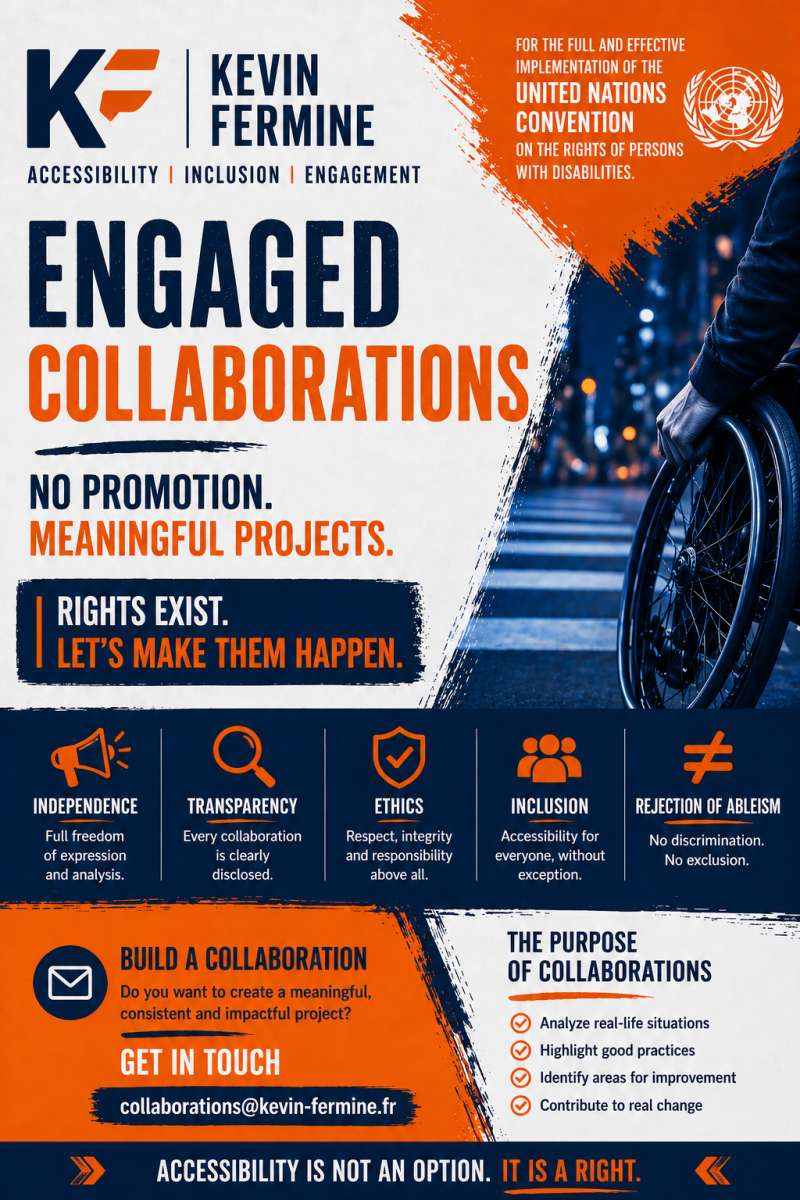
No collaboration can compromise the freedom of analysis. No content is submitted for prior approval by the partner. Observations are free, including when critical. Real experience takes precedence over any image-management logic. This principle is non-negotiable — it is the very condition for the value of the content produced.
Non-negotiable values
Every collaboration must be consistent with the principles that structure this work: real accessibility, inclusion, transparency, ethics, and an explicit rejection of ableism and exclusionary practices. These values are not communication elements: they define what I am able to defend publicly.
Selected collaborations
Collaboration proposals are considered carefully, but are not systematically accepted. Only those with genuine documentary or analytical interest, those reflecting a sincere approach, and those that respect the framework set out in this charter are retained. Volume is not an objective.
A free voice, in service of improvement
Content produced within a partnership may highlight both strengths and limitations or areas for improvement. It is precisely this capacity to name both that gives the content real utility — for readers, and for partners themselves. Content that only reports what is satisfactory is useful to no one.
Transparency towards the public
Every collaboration is clearly indicated in the relevant content. Readers must be able to identify the nature of the collaboration and the conditions under which it was carried out. This transparency is not a regulatory constraint: it is a requirement of consistency with what this work stands for.
Rejection of practices contrary to this approach
Any request aimed at steering content, limiting critique, or altering the account of lived experience results in an immediate refusal, or termination of the collaboration if the request arises during production. There is no acceptable formulation for such requests.
Useful and constructive collaborations
Beyond formal conditions, what I seek in a partnership is genuine utility: a better understanding of accessibility issues in a given sector, identification of the concrete obstacles faced by disabled people, recognition of practices that deserve it, and a contribution — modest but concrete — to changing what can be changed.
Collaboration Objectives
| Objective | Description | Means | Purpose |
|---|---|---|---|
| Inform | Provide a clear, documented picture of real-world accessibility | Articles, field reports | Understanding the issues |
| Verify | Confront stated commitments with lived reality | Real-condition testing | Bridging the gap between promise and practice |
| Highlight | Showcase practices that deserve recognition | Dedicated content | Encouraging positive initiatives |
| Support | Back genuine improvement efforts | Constructive analysis | Advancing practices |
| Raise awareness | Show real obstacles without sugarcoating them | Testimonials, concrete examples | Building awareness |
| Analyse | Apply a critical lens to sector practices | Studies and documented feedback | Better reading of the issues |
| Challenge ableism | Question exclusionary practices, name what excludes | Advocacy content | A more inclusive approach |
| Build | Develop collaborations with real impact | Targeted and evaluated projects | Concrete, measurable impact |
Conclusion – ready to collaborate ?
Collaborations are not an end in themselves. They are a means to act, to understand, and to advance practices in a sector where the gap between discourse and reality often remains considerable. They rest on a simple principle : rigour, honesty, and a shared will to progress.
If this approach resonates with your concerns, get in touch:
collaborations@kevin-fermine.fr
Rights exist. Let's enforce them.
For the strict application of the United Nations Convention on the Rights of Persons with Disabilities.