By Kévin FERMINE
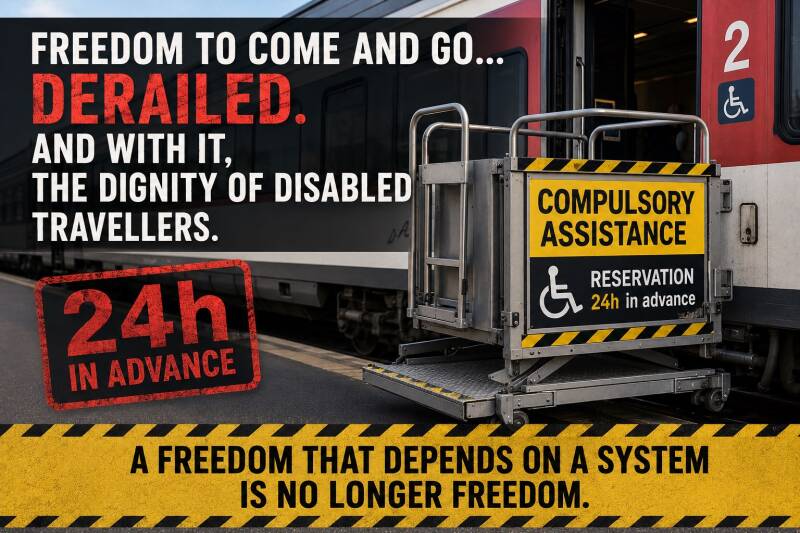
A Fundamental Freedom… With Variable Geometry
The freedom of movement is one of the cornerstones of our rule of law. It guarantees everyone the ability to travel freely, to choose their routes, and to organise their lives without depending on prior authorisation.
France presents itself as a country committed to human rights, equality between citizens, and the universality of freedoms. In theory, this freedom is the same for everyone. It should neither vary according to individual circumstances, nor be subject to particular constraints. Getting from one place to another should not require excessive anticipation or advance formalities. Everyone should be able to take a train, a bus, or a metro without it representing an organisational ordeal in itself.
Yet in practice, this equality has profound limits. For travellers with disabilities, the freedom to travel by train frequently becomes a constrained, regulated, and conditional exercise. Can we still speak of freedom when travelling requires submitting to a rigid procedure, on pain of being denied access to the train?
A Constraining and Rigid Assistance System
In France, the accessibility of rail transport still rests on an assistance system that is both cumbersome and inflexible. In order to board and alight from a SNCF train, disabled travellers are required to book assistance in advance — no later than 24 hours before departure. In 2026, stations and rolling stock remain largely inaccessible on an autonomous basis.
Once this deadline has passed, it is no longer possible to book assistance through the Assist'en Gare service. A person who contacts this service 23 hours and 59 minutes before departure will be systematically refused any support. They will then be invited to arrive at the station at least 45 minutes before departure in order to request assistance directly from staff on site — who remain free to accept or refuse on the day.
When assistance has been properly booked within the deadline, the traveller must arrive at the station a minimum of 30 minutes before departure. Past this point, assistance may be refused.
These constraints apply equally to long-distance journeys — Toulouse–Paris, Montpellier–Bordeaux, Avignon–Lyon, and so on — and to everyday travel in the Île-de-France region, including RER services connecting the suburbs to central Paris. The rigidity of the system makes no distinction based on the nature or length of the journey.
Rolling Stock and Infrastructure Out of Step
The state of SNCF's rolling stock makes clear that accessibility is not a priority. The lifting platforms essential for boarding and alighting passengers in wheelchairs are often too wide for narrow platforms, difficult to manoeuvre, frequently out of order, and in many cases obsolete.
One might hope that newly commissioned rolling stock would address these shortcomings. It does not. The TGV Océane, introduced from 2017 onwards, is the most recent illustration: corridors that remain very narrow, and toilet facilities insufficiently dimensioned to allow independent use by a wheelchair user. Faced with these criticisms, SNCF has a ready-made response: it is the passengers' wheelchairs that are allegedly "not up to standard", not the rolling stock. The reversal of responsibility is striking.
It should also be noted that trains are operated by SNCF for 30 to 40 years, sometimes longer. With a fleet renewed so slowly and accessibility standards so inadequate from the outset, there is little prospect of accessibility becoming the norm anytime soon. All the more so given that trains put into service before February 2015 are exempt from accessibility requirements. As for the December 2024 deadline set to achieve universal accessibility in rail transport, it passed without the situation on the ground matching the ambitions that had been proclaimed.
One must also question the real value of the consultations conducted by SNCF. The company regularly claims to have consulted representative disability organisations — APF France Handicap, AFM-Téléthon, and others — to validate its design choices or its accessibility master plans. But is this consultation genuinely legitimate? These organisations are not rights advocacy bodies: they are institutional managers — sheltered workshops, residential facilities, medico-social services. Their economic model is built on the institutional care of disabled people. Claiming to defend their autonomy and rights while running the very structures that depend on their dependency is a permanent and structural conflict of interest, not an incidental one. Their governing bodies are overwhelmingly composed of non-disabled people: they are not governed by the people they claim to represent, and cannot speak on their behalf.
Invoking their approval to justify inadequate decisions is not a guarantee of accessibility: it is an alibi. As long as the people directly affected are not at the heart of decision-making — not as token participants, but as decision-makers — consultation will be nothing more than a veneer of legitimacy over choices that do not belong to them.
An Insufficiently Applied European Regulation
Beyond infrastructure failures, another major difficulty persists: access to clear and reliable information about the actual accessibility of trains.
Regulation (EU) 2021/782, concerning the rights and obligations of rail passengers, nonetheless requires railway companies to provide precise information on accessibility conditions (Article 22). In practice, it is virtually impossible to obtain from SNCF:
the exact model of the train assigned to a given journey; its actual level of accessibility; the concrete conditions for boarding and alighting, and in particular whether assistance is genuinely required.
The dedicated services — Accès Plus or Assist'en Gare — are, in most cases, unable to answer these questions with any precision.
This opacity has direct consequences: it prevents travellers from making informed choices, restricts their autonomy, and compels them to book assistance as a matter of course, even when it is not needed. This is not an administrative simplification: it is an assignment.
In the same vein, Regulation (EU) 2021/782 requires railway companies to provide assistance on board — not only at the time of booking. Its Article 23 is explicit: in staffed stations, the railway company must enable boarding, transfers, and alighting, whether or not the need has been notified in advance — provided that trained staff are on duty. In unstaffed stations, it falls to the train itself to provide this assistance, if a trained member of staff is present on board. And in the absence of any trained personnel, the operator is required to "make reasonable efforts" to enable access to transport.
In practice, SNCF interprets these obligations in the most restrictive way possible. On-board assistance — help with luggage, guidance, support during a connection, access to train services — is systematically redirected to the Assist'en Gare service and its 24-hour advance booking requirement. Once that deadline has passed, the traveller is often left to fend for themselves. The regulation nonetheless explicitly provides that railway companies "shall make reasonable efforts to offer persons with disabilities access to the same on-board services as other passengers". This obligation of means is not optional. It is legally binding. And its non-compliance is subject to no serious oversight whatsoever.
Towards Real and Unconditional Accessibility
Accessibility cannot remain a conditional privilege, subject to 24 hours of anticipation and the availability of a member of staff. It is a component of the freedom of movement, and as such, it constitutes a fundamental obligation.
The legal frameworks exist — French law, European regulation, the United Nations Convention on the Rights of Persons with Disabilities (CRPD) and its Article 20 on personal mobility. What is lacking is their effective implementation and enforcement.
As long as boarding a train requires a level of organisation that most non-disabled travellers cannot even imagine, the freedom of movement will remain, for people with disabilities, a freedom with variable geometry.
All the more so given that in other European countries, things are very different — as the examples below illustrate.
Some Examples Across Europe
In Germany
Deutsche Bahn requires assistance to be booked by 8 pm the evening before travel for domestic journeys. This deadline, which may seem reasonable at first glance, in practice rules out all spontaneity: a journey decided in the evening for the following morning becomes an administrative challenge. For international journeys, the deadline extends to 24 hours before departure.
In Austria
Austria has a 12-hour deadline for domestic journeys at most stations, but some partner stations allow assistance to be booked as little as 3 hours before departure — a welcome flexibility, though still the exception. For international journeys, the deadline rises to 24 hours, and up to 36 hours for trains to Germany, Romania, or Denmark. It is also worth noting that Austrian night trains offer accessible places, unlike France where this option is sorely lacking.
In Belgium
The SNCB operates two distinct systems depending on the station. At 41 partner stations, assistance can be booked 3 hours before departure — a more acceptable timeframe. At the remaining 174 stations on the network, the deadline reverts to 24 hours. Greater clarity would be welcome: why such disparity between stations within the same country? The SNCB also offers the SNCB Assist app for booking on the go, which is a positive step in terms of digital accessibility.
In Denmark
Denmark requires 12 hours' notice for domestic journeys and 48 hours for international ones. The 48-hour deadline for international travel is particularly restrictive. There is, however, one notable exception: the S-Tog (Copenhagen's suburban rail network) is accessible without prior booking. Passengers simply need to position themselves near the first carriage and signal to the driver that they need a ramp. This is a concrete example that accessibility without advance booking is technically possible — when the political and operational will exists.
During my journey to Copenhagen, I took the train between Copenhagen and Malmö without having booked assistance in advance. Many trains are accessible autonomously or with the help of the conductor. The experience went without major difficulties — which stands in contrast to the official deadlines on paper.
In Spain
Renfe has made a notable effort at 70 stations where the booking deadline has been reduced to 30 minutes before departure — approaching something close to spontaneous access. This is a real step forward. But elsewhere on the Spanish network, the deadline rises to 12 hours. And for international journeys, it reaches 48 hours — two full days of mandatory anticipation. The disparity between stations shows that solutions exist technically: what remains is to generalise them.
In Finland
Finland has a 24-hour deadline for domestic journeys, rising to 36 hours for international ones. What sets Finland apart positively is that many trains are accessible autonomously, without the need to book assistance: the infrastructure is designed for direct access. Booking assistance thus becomes an additional option rather than a condition of access — a philosophy that deserves to be more widely adopted.
In France
SNCF requires 24 hours' notice for domestic journeys and 48 hours for international ones. Added to this is the obligation to arrive at the station 30 minutes before departure in order to receive assistance — an additional constraint that does not apply to non-disabled travellers. In France, taking a train on impulse therefore remains out of reach for many disabled people. This situation is in flagrant contradiction with the principles of equal treatment and freedom of movement.
In Italy
Italy has a dedicated assistance system called Sala Blu, managed by RFI (Rete Ferroviaria Italiana), the rail infrastructure manager. Sixteen Sala Blu offices are distributed across the country, open every day from 6:45 am to 9:30 pm, including public holidays. In theory, the system is therefore available seven days a week.
But behind this facade of national consistency lies a two-speed reality. The network distinguishes between two categories of stations: so-called "Fast" stations — the major stations where a Sala Blu office is located, plus around twenty other designated stations — and all others, categorised as "Standard".
Fast stations: booking possible up to 1 hour before departure, for trains running between 7:45 am and 10:30 pm. Outside these hours, the deadline extends to 12 hours. Standard stations: booking required at least 12 working hours before departure — working hours being defined as the opening hours of the Sala Blu offices. International journeys: a minimum of 24 hours, which may extend to 48 hours depending on the countries traversed. Connections: a minimum transit time of 30 minutes between two trains is imposed on passengers requiring assistance, compared to no such constraint for non-disabled travellers.
The Fast/Standard distinction creates an inequality of treatment based on the departure station. A traveller departing from Roma Termini has one hour to arrange their assistance. Another, departing from a "Standard" station in the evening, will have to wait for the Sala Blu offices to open the following morning for their request to be processed — which may represent well over 12 hours of real anticipation.
The requirement for 30 minutes of connection time imposed on disabled passengers is not based on a universal technical constraint, but on the human organisation of assistance: it is the system that is slow, not the person. And it is the person who bears the consequences, in the form of scheduling constraints that no one else has to endure.
It is worth noting, however, some concrete advances. The SalaBlu+ app allows users to book assistance on the go, track the real-time status of their train, and even travel in full autonomy without declaring their journey to an office. At the Sala Blu offices in Rome and Milan, an Italian sign language interpretation service is available by video call for deaf travellers, every day from 8 am to 6 pm. These are concrete efforts — but they do not compensate for the structural inequalities of the system.
In the Netherlands
The Netherlands is one of the countries with a deadline of just one hour for domestic journeys. This is an approach that acknowledges that mobility is not always planned in advance, and that disabled people have the same right to spontaneity as any other traveller. NS (Nederlandse Spoorwegen) demonstrates here that a modern rail system can adapt to short notice periods.
In the United Kingdom
The British rail network requires a 2-hour notice period, placing it among the most accessible in Europe for assistance booking. Booking is possible via a dedicated mobile app or specialist website, which simplifies the process. A 2-hour notice period nevertheless remains a constraint: it means that a decision made less than 2 hours before departure cannot be supported.
In Sweden
Sweden has a 24-hour deadline, with booking integrated directly into the online ticket purchase process. As in Finland, many trains are accessible autonomously, which reduces dependence on formal assistance. This approach — making autonomy the norm and assistance a safety net — is more respectful of travellers' dignity than the reverse model.
During my trip to Sweden in July 2024, I found things relatively straightforward. The level of infrastructure accessibility and the availability of trains accessible without assistance contrasted favourably with what I had experienced in France. It is often the train conductors who handle assistance on board. Booking is also made directly online at the time of purchasing the ticket.
In Switzerland
The CFF (Swiss Federal Railways) offer one of the most advanced systems in Europe. At major stations, the deadline is just one hour — identical to the Netherlands. Booking by telephone takes only a few minutes. Above all, the accessibility of stations and trains is documented with precision and can be consulted in advance, allowing travellers to plan their journey with peace of mind.
During my trip to Switzerland in October 2025, travelling by train proved very straightforward. Booking assistance was done by phone in a matter of minutes. The accessibility of infrastructure — both trains and stations — is precise and well documented. Many trains are accessible in complete autonomy. This is what should be found across Europe.
These examples do not constitute an exhaustive overview. They were chosen to illustrate a simple reality: alternatives exist. Other European countries have made different choices, and their disabled travellers benefit from them concretely — whether through shorter notice periods, infrastructure accessible without assistance, or digital tools genuinely designed with them in mind.
For information on assistance for disabled rail passengers, the section dedicated to passengers with reduced mobility on the Interrail.eu website is a valuable resource, often more readable than the websites of the national companies themselves.
The question, therefore, is not whether it is possible. It is possible. The question is why France — and other countries — refuse to accept this. It is not a technical problem. It is a political problem. It is a problem of priorities. And as long as it is not treated as such, taking a train will remain, for millions of disabled people, an ordeal that their non-disabled fellow citizens cannot even begin to imagine.
Accessibility is not a favour. It is a right. And a right that requires 24 hours of advance planning is not really a right at all.
© Kévin Fermine – March 2026 – All rights reserved
Article reference : B-SH-2026-011 (EN)
Ajouter un commentaire
Commentaires