Interrail and Disability: Travelling Across Europe in a Wheelchair, Between Freedom and Obstacles
Article written by Kévin FERMINE in collaboration with Interrail
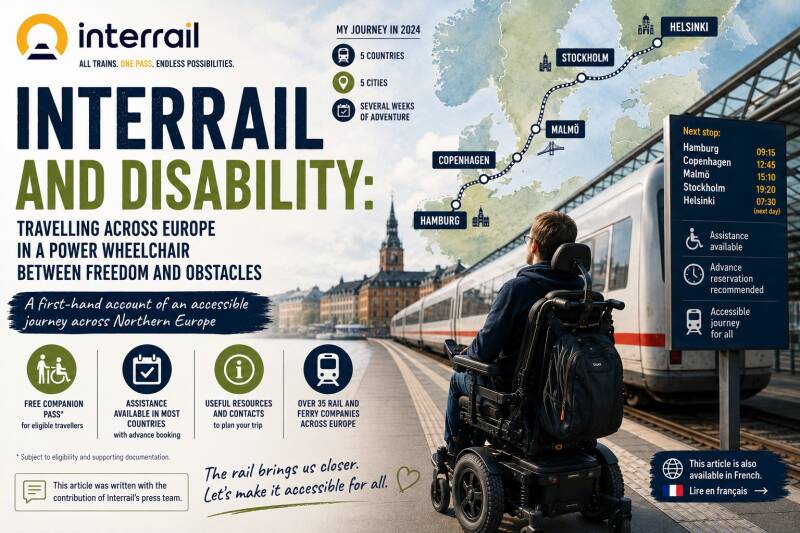
Travelling across Europe by train is a dream for many travellers. Freedom, discovery, sustainable mobility, simplicity: the Interrail Pass is often presented as one of the best ways to explore the continent. But what about travelling with a disability?
In the summer of 2024, I travelled through several European countries in my power wheelchair using an Interrail Pass. My journey took me through Germany, Denmark, Sweden, and Finland. This experience allowed me to discover both the remarkable opportunities offered by the European rail network and the difficulties that disabled travellers may face.
In March 2026, I published an in-depth article on the systemic obstacles faced by disabled people in European rail transport — restrictive assistance booking deadlines, inadequate rolling stock, insufficiently enforced European regulations, and a country-by-country comparison. This article continues that reflection, with a more practical focus: the Interrail Pass as a tool for international mobility, and the question of what Interrail does — or does not yet do — to make that journey genuinely accessible.
A Unique Freedom of Movement
One of Interrail's main strengths is the ability to travel across many European countries with a single travel pass. For people with disabilities, this formula offers a genuine opportunity for international mobility. It allows travellers to build a flexible itinerary, adapt their journey to their needs, and discover several countries without having to purchase separate tickets. In my case, Interrail made possible a several-week journey across Northern Europe — an experience I would probably not have organised in the same way otherwise.
A Little-Known Benefit: The Free Companion Pass
One of the most interesting features offered by Interrail concerns travellers who require accompaniment. Those who meet the eligibility criteria can apply for a Companion Pass, allowing their caregiver to travel free of charge. This measure is a genuine lever for accessibility: many disabled people still give up travelling because of the additional cost of having a companion with them.
I contacted Interrail's press team as part of preparing this article, to give them the opportunity to present their initiatives. Hillary, from the Eurail press team, confirmed the existence of this scheme and outlined the process: eligible travellers must submit a form along with the necessary supporting documents, available directly on the Eurail website.
Accessibility That Depends Primarily on the Railway Companies
However, it is important to understand that Interrail does not directly operate the trains. As the Eurail press team reminded me: "Our company does not own or operate the trains, but brings together over 35 railway and ferry carriers across Europe onto one Pass, meaning accessibility services vary by operator and country."
This is precisely what I analysed in my March article: assistance booking deadlines, infrastructure, staff training, and the quality of available information vary considerably from one country to another. Some countries, such as the Netherlands and Switzerland, have made radically different choices to France. These disparities are not a technical inevitability — they reflect political priorities.
Assistance: A Right That Remains Too Complex
In most European countries, railway companies offer assistance covering boarding and alighting, connections, platform access, and the use of adapted facilities. This assistance generally needs to be booked in advance with the relevant operators.
Interrail recommends contacting the relevant companies at least twenty-four hours before departure, as each operator applies its own policy regarding assistance for passengers with reduced mobility. Coordinating between several companies when a journey crosses multiple borders remains one of the major challenges — and one of the most concerning blind spots for a traveller moving from country to country.
European Rail Is Moving Forward, But at Different Speeds
During my journey, I was able to see that some countries have developed a genuine culture of accessibility while others still lag significantly behind. The accessibility of a journey does not depend solely on the train: it also depends on the stations, the information available, staff training, booking procedures, and the quality of on-site assistance.
Interrail's Position
When asked about its commitments, Interrail provided a response that I summarise here. The company states that it continues its efforts through the ongoing improvement of its website and app, testing key user journeys and incorporating feedback from users with disabilities, training its teams on accessibility best practices, and ensuring that new features meet accessibility standards.
The press team concluded with the following statement: "As an organisation committed to making travel more inclusive, we recognise that accessibility is a shared responsibility across the rail industry, and we remain dedicated to continuously improving the experience for all travellers."
These commitments point in the right direction. They will nonetheless need to be measured against the realities on the ground, which remain far more complex for many disabled travellers than institutional communications suggest. As I wrote in March: accessibility is not a favour. It is a right. And a right that requires twenty-four hours of advance planning is not really a right at all.
Travel Remains Possible
Despite the difficulties encountered, my experience remains profoundly positive. Travelling in a wheelchair across several European countries is possible. It often requires more anticipation, more preparation, and sometimes more patience. But it remains possible.
Accessibility does not mean offering special treatment. It simply means allowing everyone to exercise their freedom of movement under the same conditions as other citizens. Travel is a wonderful source of discovery, encounter, and emancipation. Disabled people should never have to fight harder than anyone else to access it.
I would like to thank Hillary and the Eurail press team for their responsiveness and availability. Their contribution has allowed this article to be enriched with a valuable institutional perspective.
© Kévin FERMINE – June 2026 – All rights reserved.
Article reference : VA-Coll. Eurail-2026-043 (EN)